


Do You Need Council Approval to Install or Replace a Pool Fence in NSW?
August 11, 2026
Installing or replacing a pool fence involves more than choosing a suitable style or material. Pool fencing must meet specific safety requirements while also complying with applicable planning and council regulations. For property owners, misunderstanding when approval is required can lead to delays, compliance issues or costly changes after the work has been completed.
Poolsafe Fencing helps navigate these requirements, including the differences between installing a new barrier, replacing an existing fence and carrying out minor repairs. The applicable approval pathway can depend on the property's location, existing approvals and the extent of the proposed work. Understanding these requirements, along with NSW swimming pool legislation and relevant safety standards, can help plan the work correctly and reduce the risk of compliance problems.
Council approval and pool fence compliance are separate requirements. A pool fence may meet the relevant safety standards but still require planning or development approval, while a project that does not require council approval can still result in a non-compliant pool barrier. Both requirements should therefore be considered before installing, replacing or substantially altering pool fencing.
Council approval concerns whether proposed work is permitted on the property and may consider factors such as:
Pool fence compliance focuses on whether the completed barrier provides the required level of safety. This includes requirements relating to:
These requirements work together but are not interchangeable. Where planning approval is required, it should be confirmed before construction. The completed barrier must then satisfy the applicable pool safety requirements, regardless of whether the fencing work itself required separate development approval.
.webp)
When a new pool is installed, the pool fence forms part of the required swimming pool barrier and needs to be considered as part of the overall approval process. The applicable pathway depends on how the pool qualifies under NSW planning rules, but regardless of the approval route, the completed barrier must satisfy the relevant safety requirements before the pool can be used.
Where a new pool requires a Development Application (DA) or Complying Development Certificate (CDC), the proposed pool barrier is considered as part of that process rather than through a separate fencing approval.
Plans should identify the proposed barrier, gates, boundary fences forming part of the barrier and relevant features near the fence. This allows the pool layout and barrier design to be assessed together before construction begins.
Some pools may qualify for exempt or complying development if they meet the applicable requirements for size, location, setbacks and site conditions. Not requiring a DA does not remove the obligation to provide a compliant pool barrier.
Property owners should still confirm that the proposed fence meets the relevant safety requirements and that any boundary fencing, heritage controls or other site-specific restrictions have been considered.
Additional planning considerations may apply where a pool is located on a constrained or sensitive property, such as a heritage-listed site, bushfire-prone area, flood-prone land or sloping block.
Where the fence relies on a boundary, retaining wall or other structure as part of the barrier, the proposed design may need closer assessment. Checking the applicable requirements before construction can help prevent changes being required after the fence has been installed.
Not every change to an existing pool fence requires council approval. Minor maintenance or a genuine like-for-like replacement may qualify as exempt development where all applicable requirements are met. However, council or certifier input may be needed when changes affect the position, height, structure or function of the pool barrier.
Approval requirements may need to be checked when:
These changes can affect setbacks, boundary requirements, climbable zones and the approved arrangement of the pool area. A fence that satisfies pool safety requirements may still require planning approval, while an approved development must still result in a compliant pool barrier.
Replacing or repairing an existing pool fence does not automatically mean council approval is required. The key consideration is the nature and extent of the work. Minor repairs and genuine like-for-like replacements may qualify as exempt development, subject to the planning controls that apply to the property.
Regardless of the type of work, the completed barrier must satisfy the applicable pool safety requirements. Owners should also consider whether landscaping, ground levels or nearby structures have changed since the original fence was installed.
Routine repairs that restore a fence without changing its location or design may not require council approval. Here are examples:
Repairs should not introduce new gaps, climbable features or other safety issues. If the work changes the design or performance of the barrier, it may need to be considered as a more substantial alteration.
Replacing an existing pool fence in the same location with a compliant equivalent may be able to proceed as exempt development, depending on the applicable requirements. The replacement should maintain or improve the barrier's safety performance and comply with the requirements that apply to the new work.
A replacement fence should not simply reproduce defects in an existing barrier. If the old fence is too low, has excessive gaps or has an unsuitable gate, those issues should be addressed as part of the replacement.
More substantial work is more likely to require council or certifier input where it changes the position or function of the barrier. This may include:
These changes can affect setbacks, climbable zones, access and other planning or safety requirements. Where the approval pathway is uncertain, confirming the requirements before work begins can help avoid having to modify a completed fence.
Pool fencing must be designed to prevent young children from accessing the pool area without supervision. This means the barrier needs to meet requirements for height, gaps, climbable features and gate operation, rather than simply providing a physical boundary around the pool.
For most residential pool barriers, key requirements include a minimum height of 1.2 metres, controlled gaps and a self-closing, self-latching gate. Boundary fences used as part of a pool barrier can be subject to different requirements and should be assessed according to their specific circumstances.
For most internal pool barriers, the fence needs to be at least 1.2 metres high, measured in accordance with the applicable requirements. The barrier must also maintain appropriate clearance from the ground, with gaps limited to 100 mm.
Where a boundary fence forms part of the pool barrier, different requirements can apply. A standard dividing fence should therefore not automatically be assumed to satisfy pool safety requirements.
Ground levels, paving and landscaping should also be checked because changes around the fence can reduce its effective height or create additional gaps.
A compliant fence must also be protected from nearby objects that could help a child climb over it. Furniture, planter boxes, retaining walls, garden structures and other potential footholds should be kept outside the required non-climbable zone.
The fence itself should also avoid features that provide convenient handholds or footholds. This is important when replacing an existing barrier because changes to landscaping or structures may have created new climbing points.
Pool gates must open away from the pool and be self-closing and self-latching. The latch must be positioned or protected so it cannot be easily operated by a young child.
Gates and their hardware should remain in good working order. A loose hinge, damaged latch or gate that no longer closes correctly can compromise the barrier even when the fence panels remain compliant.
The fence, gate and surrounding area should therefore be assessed as one complete pool barrier. Checking these details before installation or replacement can help identify issues before a formal compliance inspection.
A boundary fence can form part of a pool barrier, but it must satisfy the requirements that apply to pool barriers rather than simply those for a standard dividing fence. An existing boundary fence should be assessed before it is relied on to restrict access to the pool.
A standard boundary fence may need modification before it can form part of a compliant pool enclosure. Depending on its design and the site, this could involve increasing its height, closing gaps or addressing features that provide footholds or handholds.
Where substantial changes are proposed, the applicable planning requirements should be checked before work begins. If the boundary fence cannot be made compliant or the required modifications are impractical, a separate pool barrier within the property may provide a more straightforward solution.
The boundary fence should be assessed as part of the complete pool barrier rather than as a separate structure. This helps identify safety and planning issues before construction and reduces the risk of problems during compliance assessment.
Site conditions can affect whether pool fence work qualifies as exempt development or requires further approval. A straightforward replacement in the same location is less complex, while work involving ground levels, retaining walls, decks or boundary structures may require additional assessment.
Before construction begins, the fence should be considered together with the surrounding site. Changes to the ground, nearby structures or drainage can affect both planning requirements and the performance of the pool barrier.
Sloping blocks can make pool fence installation more complicated, where excavation, filling or retaining work is required. Changes to ground levels can affect the effective height of the barrier, drainage and the work required around the fence.
Approval requirements may need to be considered where the work involves excavation or filling, affects neighbouring drainage or requires retaining structures. Ground levels should also be checked to ensure they do not create climbable areas around the barrier.
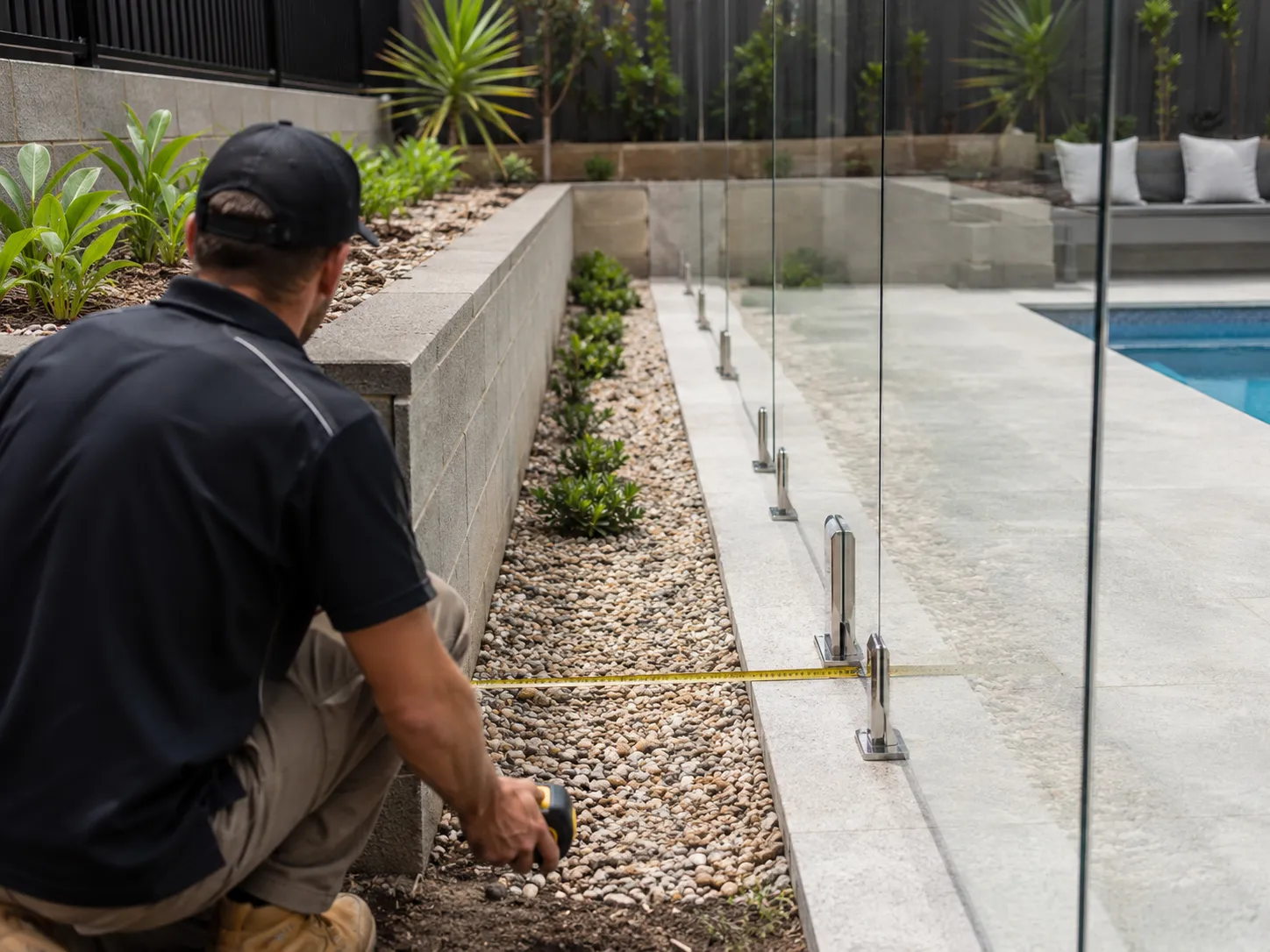
Retaining walls, decks, steps and other structures near a pool fence can affect how the barrier performs. A retaining wall may reduce the effective fence height or create a foothold, while a deck or raised platform can provide access to the barrier.
Where these structures are being built or modified as part of the project, the relevant planning and pool safety requirements should be considered together rather than treating the fence as a standalone structure.
A boundary fence used as part of a pool barrier may involve additional planning and neighbour considerations, particularly if its height, position or structure is being changed. The owner should also check whether the proposed fence alignment crosses an easement or is close to underground services.
Where substantial changes are planned, confirming the requirements with the local council, certifier or relevant service provider before construction can help prevent delays, disputes or costly alterations.
Where certification is required, the completed pool barrier must be inspected to confirm that it complies with the applicable safety requirements. The assessment covers more than the fence panels themselves and can include the gate, gaps, height, surrounding structures and potential climbable features.
A compliance inspection can be carried out by the local council or an appropriately authorised private certifier. A builder or fencing contractor may check the installation before inspection, but their assessment does not replace formal certification where certification is required.
The complete barrier may be assessed for:
The surrounding area is important because landscaping, retaining walls, decks, furniture or changes in ground level can create a compliance issue even when the fence itself meets the required measurements.
If defects are identified, they will need to be addressed before the barrier can be certified as compliant. Common issues can include inadequate gate operation, excessive gaps, insufficient height and climbable features near the fence.
After repairs or modifications are completed, a further inspection may be required. Addressing potential problems before the formal inspection can help reduce delays and avoid unnecessary rework.
Where the barrier passes the required assessment, the appropriate compliance documentation can be issued and recorded through the NSW Swimming Pool Register. Owners should continue checking the fence, gate and surrounding area because later changes or deterioration can affect ongoing compliance.
Understanding whether council approval is required for a new or replacement pool fence is an important part of planning the work correctly. Requirements can vary depending on the property, existing approvals and the type of work proposed, while the completed pool barrier must still satisfy the applicable safety requirements. Planning controls, the Swimming Pools Act and relevant Australian standards can influence how the project needs to be approached.
Where there is uncertainty about whether a development application, complying development pathway or other approval is required, property owners should confirm the requirements with their local council or a qualified certifier before work begins. Poolsafe Fencing can also assess their pool barrier requirements and identify potential compliance issues before installation or replacement. Taking these steps early can reduce unnecessary rectification work and support a safer, compliant pool area.

